An Intro to IFS Parts Work from a Trauma Therapist in Sacramento
I’m a trauma therapist in Sacramento and in my last blog post I shared resources for somatic healing. Today I’d like to provide an introduction to my other most frequently used modality, Parts work.
The most popular and most well-known form of Parts work is called Internal Family Systems, also known as IFS. Especially in the past few years, IFS has gained more attention with celebrities speaking publicly about how the model has helped them. In fact, Alanis Morissette wrote the intro to IFS founder Dr. Richard Schwartz’s book No Bad Parts: Healing Trauma and Restoring Wholeness with the Internal Family Systems Model. (Also available at Sacramento Public Library)
So what is Parts work?
I’ll try to break it down as succinctly as I can!
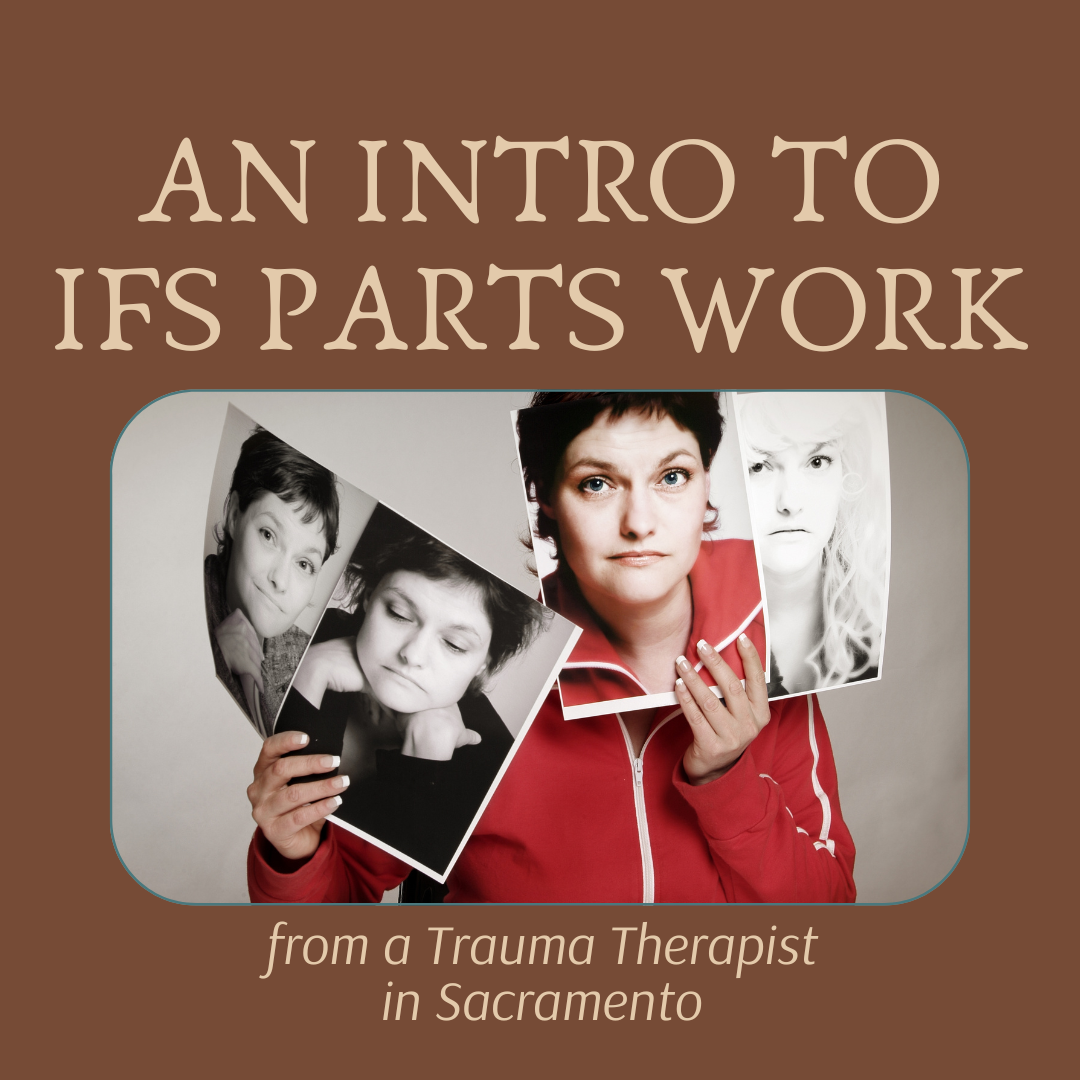
Parts work is based on the premise that we all have different parts of ourselves, sub-personalities.
These different Parts can often be in conflict with one another. If you’ve ever felt a sense of internal conflict, that’s how you know you have Parts!
Sometimes a particular Part may get in the driver’s seat, so to speak, and get us to engage in behaviors we know aren’t really good for us.
Some Parts you may already be familiar with are an inner child, or an inner critic.
The model is called Internal Family Systems because we work with the dynamics and interactions between the different parts of ourselves just like a therapist would work with the dynamics and interactions between different family members in Family Systems Therapy.
In this video, Dr. Richard (Dick) Schwartz explains IFS better than I can:
Protective Parts
The first kind of Parts you should know about are Protector Parts. As the name suggests, they try to protect us from our pain. These Parts often keep certain painful memories, emotions, and/or wounded Parts outside of our conscious awareness.
Protector Parts can definitely pose a challenge in trauma therapy, which is why we need to move slowly and carefully at first. As author Stephen Covey says, “Change moves at the speed of trust.”
Protector Parts come in two different subtypes with seemingly opposite strategies—Preventative Parts and Reactive/Extreme Parts.
Preventative Parts
Preventative Parts are what Dr. Dick Schwartz refers to as Managers. I’ll use the two terms interchangeably.
Preventative Parts like to be in control. As the name implies, Managers run our day-to-day lives. They are often hardworking and exhausted.
Managers can often be judgmental and present as an inner critic. They monitor and criticize our actions. They inhibit us and try to get us to play by the rules.
Managers operate according to their established beliefs about life, which are typically learned implicitly from our family of origin and/or the culture we grow up in early in life. These beliefs are usually unconscious and often go unquestioned until you come to therapy or have your own “aha” moment of self-reflection.
Preventative Parts (again, as the name suggests) prevent us from feeling pain, typically by inhibiting us or getting us to avoid triggers for pain.
Feelings of guilt and people pleasing behaviors are common with Preventative Parts, as is worrying and wanting to look good. These Parts get us to conform and to be socially acceptable (often in a way that is unintentionally hurting us or just not working anymore, which is why many people come to therapy).
Reactive or Extreme Parts
Preventative Parts try to prevent our pain from coming to the surface. They keep it locked in the basement of our psyche, so to speak.
Reactive or Extreme Parts become active when our pain pops up into conscious awareness. They only show up once our wounds have been activated and they only care about one thing—stopping the pain.
Distractors or avoidant Parts let us escape from the pain temporarily by putting our focus on something else. This can look like many seemingly-innocuous behaviors that many people engage in on a daily basis: bingeing your latest favorite show on Netflix, mindlessly scrolling through social media, eating when you’re not really hungry, drinking a glass of wine or two after work. The list goes on.
Workaholism is a frequent tool of distractor Parts as well. Many of these behaviors are commonplace and considered socially acceptable, so they may go unnoticed and unchecked.
Reactive Parts can also be more extreme. Dick Schwartz calls these Parts Firefighters. They take quick, intense action to put out the fire of the pain. This can look like drug and alcohol use, bingeing and purging, cutting or other self-harm behavior, risky sexual behaviors, or even suicidal thoughts or actions.
Even though they both carry the intention of keeping us pain-free, Managers and Firefighters can often be in conflict because Firefighters generally engage in behaviors that are not considered socially acceptable, while managers try to keep us in line and operating within cultural norms.
Parts That Carry Our Hurt and Pain
I’ve shared about two different kinds of protective parts (Preventative Parts and Reactive/Extreme Parts). Now we’ll get into what they’re protecting.
We all have parts that carry our hurt and pain. These hurtful and painful experiences are simply a part of life, and even more significant for those of us with a history of trauma.
Impactful painful experiences often occur early in our lives, so the Parts that carry hurt and pain are often vulnerable and child Parts. Trauma fragments us and these Parts become frozen in time, carrying the burden of the painful experience.
When we push these wounded Parts away, outside of our conscious awareness, they become what Dick Schwartz calls Exiles. These are the Parts I mentioned that we keep locked in the metaphorical basement of our psyche. They are exiled in an attempt at self-protection, because our system (our mind and nervous system) sees the painful burdens they carry as dangerous.
We need to get permission from Protective Parts to access the Parts that carry pain.
Protective Parts can be tough to work with. I love people’s vulnerability. I love the inner child, my own and my clients’, and I’m so eager to connect with and nurture those inner little ones. I love hearing people’s stories, even the painful ones. But I have to slow my roll…
In trauma therapy, and especially in IFS Parts work, we have to go slowly. We have to move at the speed of what feels safe.
We can’t bypass the guard at the door and jailbreak the exiled Parts. If we try to access the pain too quickly, there can be backlash from the Protector Parts. This can look like falling back into addictive behaviors, other self-sabotaging behavior, or even suicidal ideation.
So the beginning stages of IFS therapy or self-help work are working with the Protector Parts—seeing them, being present with them, acknowledging them—until they trust us enough to let us contact the more vulnerable places inside.
There are no bad Parts.
Many of us come to therapy or begin a self-help journey because we feel the negative consequences of our Parts in action. An inner critic (Manager) Part makes us feel like we’re never good enough. Or a reactive Part causes us to slip into addictive behaviors that we know hinder our progress towards our goals. At a certain point, the Parts and their modus operandi start to do us more harm than good.
You might think, “I hate this Part! Can’t I just get rid of it?!” But it doesn’t really work that way.
Something important to know is that there are no bad Parts. Dr. Dick Schwartz, founder of IFS, gave his book this title for a reason.
Parts all have good intentions. They are all just doing their best, trying to protect us and trying to help us survive (albeit, often in ways that are misguided given the current circumstances of our lives).
I’ll let you in on a little secret, one of the universal truths of trauma healing, something I’ve observed in myself and in my clients—The behaviors that kept you safe earlier in your life are now holding you back.
It may sound counterintuitive, but it’s when we come to accept (and even love) each and every Part of ourselves, that those Parts stop causing so much trouble in our lives.
“The curious paradox is that when I accept myself just as I am, then I can change.”
Self Energy
In addition to the Parts I’ve described, we all have what IFS practitioners call Self energy. Other traditions might call this your Higher Self or Wise Self.
It’s our inner wisdom and internal guidance system. I think of it as my soul. It’s our most evolved self and what remains when we strip everything else away.
The 8 Cs
The Self is not a Part, it’s a state of being.
IFS uses eight words that all begin with the letter C to describe the qualities of Self energy. The “eight Cs” are confidence, calm, compassion, courage, creativity, clarity, curiosity, and connectedness.
Please don’t get hung up on trying to memorize those eight c-words! It’s really not important. The words that come to mind for me when describing Self energy are centered, grounded, open, and loving.
Access Points to Self Energy
Each of us will have our own go-to ways of accessing Self energy. For some, it’s meditation, or journaling. For others it might be physical activity, or time in nature. Or perhaps it’s making art, listening to certain music, or other creative pursuits.
Try to think back to the moments you have felt most present, connected, spacious, or openhearted. What were you doing?
If you’re not sure of your personal pathways to Self energy, try on different activities and notice how you feel. Don’t worry if it takes a bit of trial and error to find what works for you.
Where to start? Give it a name.
Want to try Parts work on your own? An easy first step is to give those internal voices a name. This is especially helpful with an inner critic (Manager).
Besides just giving it a name, you can create a whole character out of it. Imagine how they would look, how they would dress, where they would live, etc. How old is this character? What gender are they? They might be a human, or an animal, or a fantastical creature. Be creative!
Giving the voice a name begins the process of “unblending,” which is differentiating the Parts from your most authentic Self.
I love this practice. I have repeatedly gotten feedback from my trauma therapy clients over the years about how helpful they’ve found it. Many have shared it with friends and loved ones too!
Explore IFS Parts Work with a Trauma Therapist in Sacramento
If you’d like to try Parts work on your own, I recommend starting with Dr. Richard Schwartz’s book No Bad Parts, or with the resources I’ve listed in the section below.
I love Parts work and there is certainly self-help work that can be done with it, but IFS is one modality that I personally believe is best done with a guide. One reason for that is to ensure safety and pacing, and to avoid the backlash phenomenon I shared about.
If you live in the Sacramento area and want to heal trauma through Parts work, I would love to be that guide!
I combine Parts work with somatic therapy and in my experience, that makes it more effective. Traditional ways of doing IFS can get a little cerebral, and I’m passionate about integrating the mind, body, and spirit.
If you’re interested in exploring Parts work with me, contact me today for a free phone or video consultation.
Resources
Inner Active Cards are a deck of illustrated cards, an IFS tool, that I use with my in-person trauma therapy clients. Understanding Parts with Inner Active Cards is a page from their website that I frequently refer clients to, as it describes many different types of Parts in a clear, understandable way, with plenty of pictures to illustrate.
If you plan to try Parts work on your own, I recommend purchasing a deck of Inner Active Cards!Dick Schwartz has a series of free guided meditations based on Internal Family Systems on the Insight Timer app.
Dick Schwartz was a guest on two episodes of the We Can Do Hard Things podcast:
“Inside an Internal Family Systems (IFS) Therapy Session with Glennon & Richard C. Schwartz” and “Abby & Amanda’s IFS Therapy Sessions with Richard Schwartz: Why We Do What We Don’t Want to Do”In this video from my favorite IFS Master Trainer, Dr. Frank Anderson, he explains the three main steps to healing trauma: